
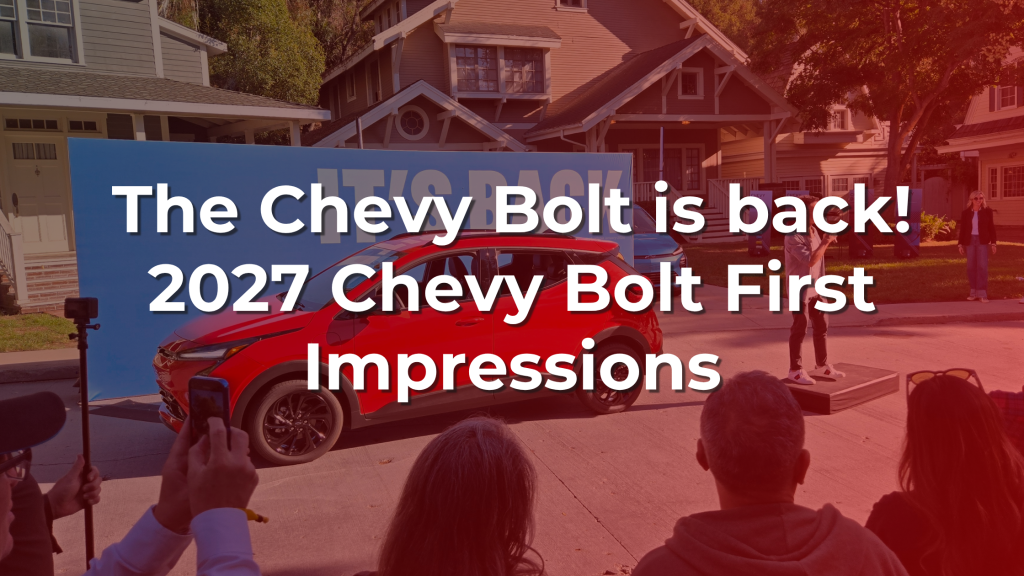
The Chevy Bolt is Back! 2027 Chevy Bolt First Impressions
Author: John Fitzmaurice, ENE Dealership Outreach and Training Specialist; Opinions are that of the author and may not be the express opinions of Energy New England or it’s Drive Electric Programs.
On October 8, 2025, I had the opportunity to see and drive the new 2027 Chevrolet Bolt at Universal Studios in Los Angeles. Chevrolet hosted a Block Party event for EV Vloggers and current Chevy Bolt EV and EUV owners on the back lot of Universal Studios where they introduced guests to the new 2027 Chevy Bolt. As Bolt owners since 2017 and big EV advocates, Chevrolet reached out to invite me and my wife to the event. We currently own a 2019 Chevy Bolt EV Premier and have also owned a 2017 and a 2020 Bolt EV. Note: Chevrolet paid for our flight and accommodations, but the following report, observations, and opinions are my own.
A little Chevy Bolt history
The first Chevy Bolt was released in 2017. The model was called the Chevy Bolt EV. It was sold in two trims: LT and Premier. The LT and the Premier shared the same electrical and mechanical components, such as inverter, motor, battery, battery management system, and brakes. Where they differed was in creature comforts such as higher end heated seats and heated steering wheel, Bose stereo system, and aesthetic features such as alloy wheels, interior lighting, and roof rails. In 2017, the Bolt EV Premier sold for over $41,000. In 2021, a slightly bigger brother to the Bolt EV, the Bolt EUV was introduced. The EUV was about 6 inches longer and 1 inch taller than the EV. The EUV was released in 3 trims. The EUV included Chevrolet’s driver assistance feature called Super Cruise. A sunroof and heated and ventilated front seats were offered as options. The EUV sold for between $33,000 and $42,000 depending on the trim and options. At the same time, Bolt EVs were selling for under $30,000. Both the EV and the EUV models were discontinued by GM at the end of 2023. However, on July 25, 2023, GM announced that they will bring back the Bolt “at some time in the future”. They also announced that the new Bolt will utilize their new Ultium battery technology. GM did not provide any details as to when and in what form the Bolt would return. I would like to think that the popularity of the EV among current Bolt owners influenced GM to change their mind and return it to GM’s lineup.
Well, the Chevy Bolt is back!
 Chevrolet is calling the new release simply the 2027 Chevy Bolt – no EV or EUV title. The new Chevy Bolt has almost exactly the same dimensions as the original Chevy Bolt EUV – down to tenths of an inch. The 2027 Chevy Bolt is equipped with a 65kWh lithium-iron-phosphate (LFP) battery which is a departure from the original nickel-cobalt-manganese-aluminum (NMCA) battery. The LFP battery pack is composed of cylindrical cells unlike the NMCA battery pouches found in the Chevy Equinox EV and Chevy Blazer EV. LFP batteries offer significant advantages over NMCA’s, including enhanced safety due to thermal stability, durability, and a long cycle life measured in the thousands. The estimated range for the new Bolt is 255 miles on a single charge with a charging speed of 10%-80% in 25 minutes at 150kW (DCFC / Fast Charger). This is a three-fold increase in charging speed over the previous models!
Other 2027 Bolt features and observations:
 The 2027 Bolts that I saw and drove at the events were pre-production, engineering run models. The Chevy engineers said that they were at least 95% identical to the final design. The charging port has changed to NACS versus the bulkier CCS combination charging port. This will allow the 2027 Bolt to support “Plug and Pay” charging. No need to use a credit card or open an app to initiate a charge at a participating NACS fast charging location. It has a heat pump! The older models utilized a resistive heating system which requires 2-3 times the amount of energy to maintain temperature. The Bolt EV runs on the Android Automotive system for tight vehicle integration. This is not to be confused with Android Auto. Just like all Chevy EV’s manufactured after 2023, Android Auto and CarPlay are not supported – much to the disappointment of many current Bolt owners. This means that owners will not be able to access their Android or iPhone apps on the Bolt’s display screen. Android Automotive will offer its own apps designed for the new Bolt. The new Bolt is sold as Front Wheel Drive (FWD) only. All Wheel Drive (AWD) is not an option. Super Cruise, GM’s assisted driving system, is optional on all trim levels. A sunroof that opens to let in air, is optional on the new Bolt. The Chevy Bolt can be integrated with the GM Home Energy System to provide emergency power back up to your home. The gear shifter has moved to the stalk on the right side of the steering wheel. P R N D are switched electronically. The act of “putting the car in gear” is reminiscent of the gear shifts on old ICE vehicles; Pull the stock towards you and lift up to put the vehicle in reverse and down to put it in drive. Chevy Bolt EVs sold between 2017 and 2020 featured an electronic gear shift on the center console and with PRNDL gear settings. Shifting to D essentially removed regenerative braking. Lifting your foot off the accelerator in D allowed the vehicle to coast like an ICE vehicle. Shifting to L added regenerative braking which enabled one pedal driving (OPD). Lifting your foot off the accelerator in L caused the vehicle to engage regenerative braking to stop the vehicle and feed power back to the traction battery. It was easy to switch from D to L at any time by simply pulling down on the shifter. The Bolt EV and EUV models from 2021 to 2023 removed the L gear and utilized PRND buttons on the center console to shift gears plus a separate button to engage OPD. Lifting your foot off the accelerator while in D caused the vehicle to coast like an ICE vehicle. Lifting your foot off the accelerator while in D with the OPD option activated caused the vehicle to engage regenerative braking. The new Bolt does not have an L gear on the electronic gear shift or a physical one-pedal-driving button. One pedal driving on the new Bolt is activated through the touchscreen. In my opinion, this makes switching between D and one pedal driving a little more difficult than either method found in previous models. Why would you want to switch from one pedal driving to non-regenerative braking while driving? Encountering slippery road conditions can be disconcerting or downright dangerous when regenerative braking engages especially without AWD. It is a bit dangerous to have to look at the touchscreen for the one pedal driving setting when suddenly encountering a slippery patch on the road. The old method of switching back and forth from L to D on the shifter did not require the driver to take their eyes off the road. I used this feature quite often. It was similar to driving a standard. Once you got the hang of shifting gears on a standard, you no longer needed to look at the gear shift. You just used your muscle memory. The regen paddle has been removed from the new Bolt. Previous Bolt EV and EUV models included a regen paddle on the back of the steering wheel. When the paddle was pressed, the vehicle would temporarily utilize regenerative braking regardless of the driver’s gear setting. It was a handy feature which allowed the driver to slow down or stop the vehicle without engaging the brakes. All that being said, the new Chevy Bolt addresses slippery road conditions by including a Snow / Ice Driving Mode option which optimizes traction for slippery conditions by adjusting the throttle response to slow down acceleration and limit torque. 2027 Chevy Bolt Pricing: $28,999 for the LT model. $29,999 for the LT Comfort. $32,000 for the RS. Prices include destination charges. The RS will be released first in early 2026. Chevrolet reported that the new Bolt would be available for a “limited time” although they did not define the “limited time”. My guess is that since the LFP batteries are sourced from CATL – a battery manufacturer in China, GM may be concerned with supply and the current administration’s arbitrary changes to import tariffs. GM is building a battery manufacturing plant in the US which should ease their concerns. I got to test drive the new Bolt on Universal Studios’ backlot for 30 minutes stopping at various filming locations. Driving was smooth, and quiet. Although I could not test acceleration on the back lot, the vehicle felt zippy with no hesitation when pressing the accelerator. The seats were softer and more comfortable than the somewhat harder seats of the previous Bolt EV’s. At 6 feet tall, I had no problems fitting in the new Bolt’s front and back seats. The back seat was as roomy as the Bolt EUV with 3 more inches of legroom than the Bolt EVs.
Comparison:
| 2017 – 2019 Chevy Bolt EV | 2020 – 2023 Chevy Bolt EV | 2021 – 2023 Chevy Bolt EUV | 2027 Chevy Bolt | |
| Length | 163.20 in. | 163.20 in. | 169.50 in | 169.60 in. |
| Width | 69.50 in. | 69.50 in. | 69.70 in. | 69.70 in. |
| Height | 63.40 in | 63.40 in | 63.60 in. | 63.90 in |
| Wheelbase | 102.4 in | 102.4 in | 105.30 in | 105.30 in. |
| Battery | 60kWh NCMA | 65kWh NCMA | 65kWh NCMA | 65kWh LFP |
| Range (est.) | 238 mi | 259 mi | 247 mi | 255 mi |
| Max Charge Rate (DCFC) | 55 kW | 55 kW | 55 kW | 150kW |
| 10% – 80% charge time | 75 minutes | 75 minutes | 75 minutes | 25 minutes |
| DCFC Connector | CCS combo | CCS combo | CCS combo | NACS |
Conclusion:
With a charging speed that is 3 times faster than previous models, and a NACS charging port, this EV can tackle road trips with relative ease. Add to that, a starting price of $29K, the 2027 Chevy Bolt is a compelling and affordable electric vehicle.