
As I prepared for a recent road trip from Central Massachusetts to Virginia’s Shenandoah Valley, I found myself thinking back to stories some of my colleagues had shared over the years about traveling long distances in electric vehicles.
A common theme in many of those experiences was that long-distance EV travel often felt easiest in a Tesla because of the Supercharger network. Other EVs could make the trip, but it usually required more planning and came with fewer charging options.
This trip highlighted how much things have changed.
Driving my 2023 Hyundai Ioniq 5 SEL nearly 500 miles each way, I relied entirely on CCS charging and didn’t have a NACS adapter. Between Electrify America, IONNA, Pilot/Flying J, Rivian chargers near my destinations, and numerous other charging options along the route, I had more charging choices than I actually needed.
The question was rarely, “Can I charge?” It was, “Which charger should I use?”
But before I get too far ahead in the story, I should mention that the most stressful part of the trip had nothing to do with charging.
It happened before I ever left my driveway.
Planning for the Trip
 This was the longest EV trip I’d ever taken. My previous longest drive in the Ioniq 5 was a trip to Portland, Maine—about 130 miles away and easily achievable without charging along the way.
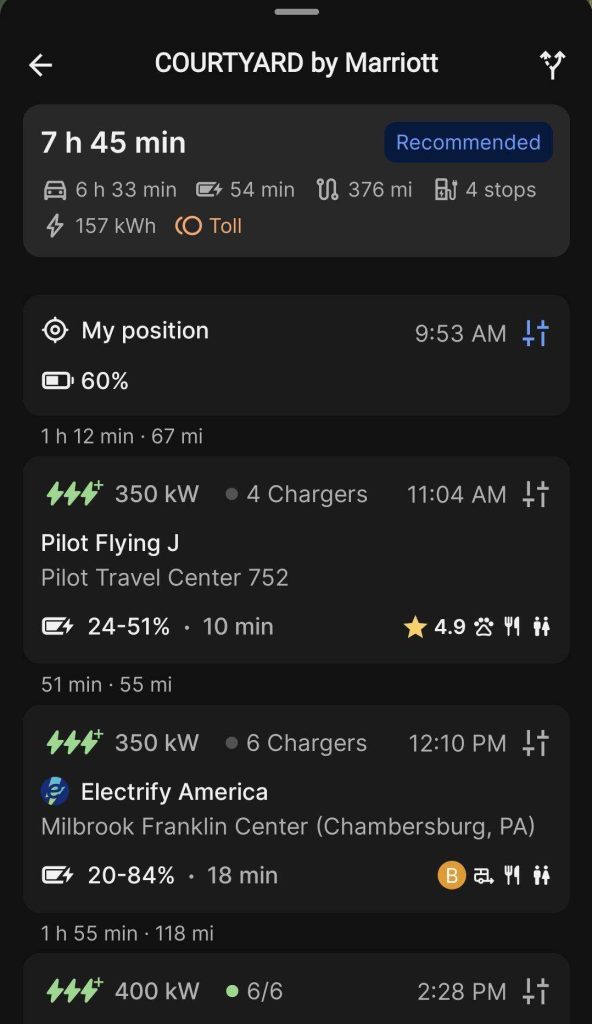
For this trip, I spent some time planning with A Better Route Planner (ABRP) and then reviewed charging locations in PlugShare.
ABRP helped me rethink how I approach road trips. Instead of driving until I absolutely needed a break, I planned several shorter charging stops spaced roughly 1.5 to 2 hours apart. I also used PlugShare to review station reliability, amenities, and recent user experiences.
One of my biggest takeaways from the planning process was how much the selected charging networks influence the route. I ended up adding some networks, including IONNA and Pilot/Flying J locations, even though I had never used them before. The locations were convenient, the pricing was competitive, and PlugShare reviews gave me confidence they would be reliable.
The planning took a little extra time, but it also eliminated uncertainty. We knew where we would stop, what amenities were available, and what to expect when we arrived.
Day One: A Smooth Start
We left home with a full battery after charging overnight.
Our first day was intentionally short, about three hours of driving, and we made it to our hotel without stopping to charge.
When we arrived, I discovered something interesting about EV travel today: availability isn’t the same thing as convenience.
There were chargers at the hotel and additional chargers at two nearby locations. Before plugging in, I checked PlugShare and found that a DC fast charger at a nearby hotel was roughly $0.20 per kilowatt-hour less expensive than the one on-site.
Since I had multiple options, I simply chose the less expensive one.
That flexibility became a recurring theme throughout the trip. Rather than searching desperately for a charger, I was often choosing between several good options.
Charging Was Remarkably Easy
The second day included our longest stretch of driving.
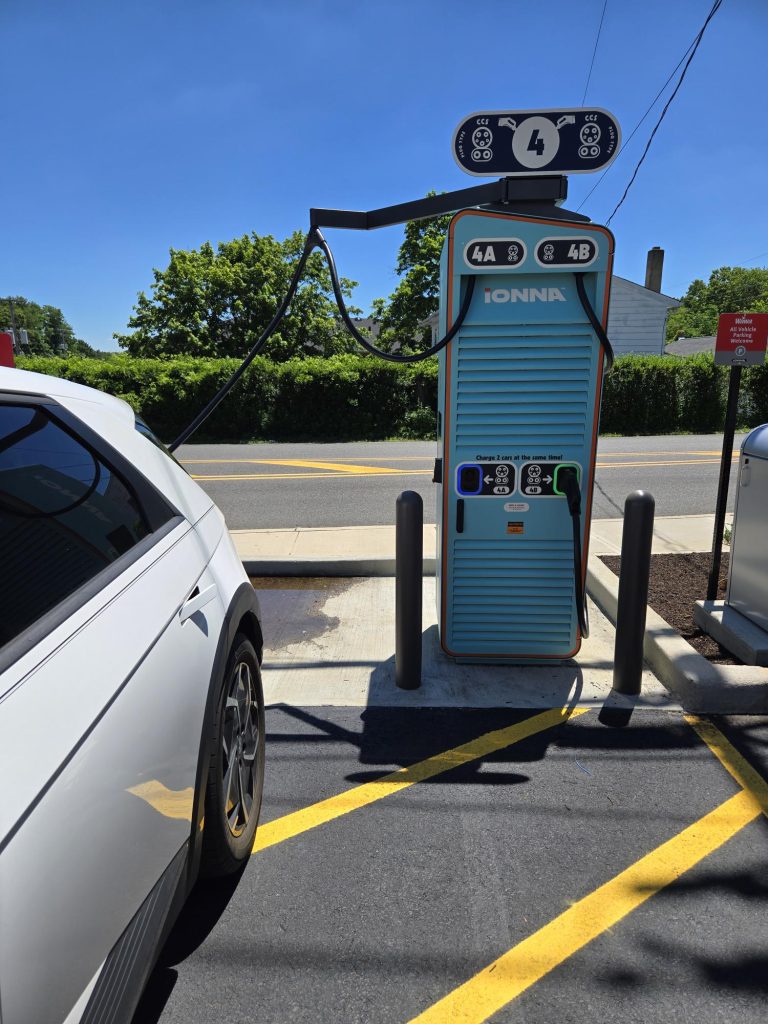
We had planned approximately three charging stops spaced throughout the day and one final stop about 45 minutes before reaching our destination. Since our relatives didn’t have a dedicated EV charger, I wanted to arrive with a comfortable amount of charge remaining rather than relying entirely on Level 1 charging from my portable charging cord.
At nearly every stop, the process was simple:
Plug in.
Tap my phone or use an app.
Walk away.
Most of our charging sessions lasted only about 12 to 15 minutes because we were mostly topping off the battery rather than charging from very low levels.
In reality, the charging sessions were often shorter than our breaks.
By the time my partner and I walked inside, used the restroom, grabbed a snack or drink, stretched our legs, and got back outside, the car was usually ready to continue.
More than once, one of us looked at the charging screen and said:
“Oh, it’s done already?”
We had planned to spend a little time scrolling our phones or reading, only to discover the vehicle was ready before we were.
If we had been traveling with young children or pets, I’m convinced the car would have been ready long before the passengers.
The fastest charging session reached approximately 233 kW—essentially the maximum charging speed for my vehicle.
I also learned more about the Ioniq 5’s charging curve. Charging stays incredibly fast up to around 80%, slows noticeably after that point, and becomes even slower once you move past 90%.
Even so, I appreciated leaving the vehicle’s maximum charge setting at 100% during the trip. The extra battery buffer reduced stress and gave me flexibility if a stop took a little longer than planned.
The Challenge Before the Journey
Now for the part I haven’t mentioned yet.
A few days before the trip, I installed a new dash cam.
Unfortunately, it appeared to be drawing power from the 12-volt battery.
One weekend before we were scheduled to leave, I started the car and immediately received a warning about the 12-volt battery. Shortly afterward, the vehicle stopped functioning altogether.
To make matters worse, my jumper cables were stored in the trunk.
Which I couldn’t open due to no power.
Lesson learned.
Fortunately, a neighbor had jumper cables and helped get the vehicle running again.
My anxiety, however, remained.
We tried adjusting settings and troubleshooting the issue. Then the day before our trip, the battery died again.
At that point, the conversation wasn’t whether we would go—it was how.
Should we take our older vehicle?
Rent a car?
Fly instead?
After some research, we concluded that the likely culprit was the original 12-volt battery. The vehicle was three years old, purchased off lease, and the battery appeared to be original equipment.
We purchased a replacement AGM battery and installed it ourselves on the morning of departure.
Just in case, we moved the jumper cables to the frunk. Unlike the trunk, I can always access the frunk using the manual key and manual hood release.
That gave us a backup plan and some additional peace of mind.
Then we hit the road.
And that was the end of the issue.
No warning lights.
No battery problems.
No interruptions.
The rest of the trip was completely uneventful.
Learning Along the Way
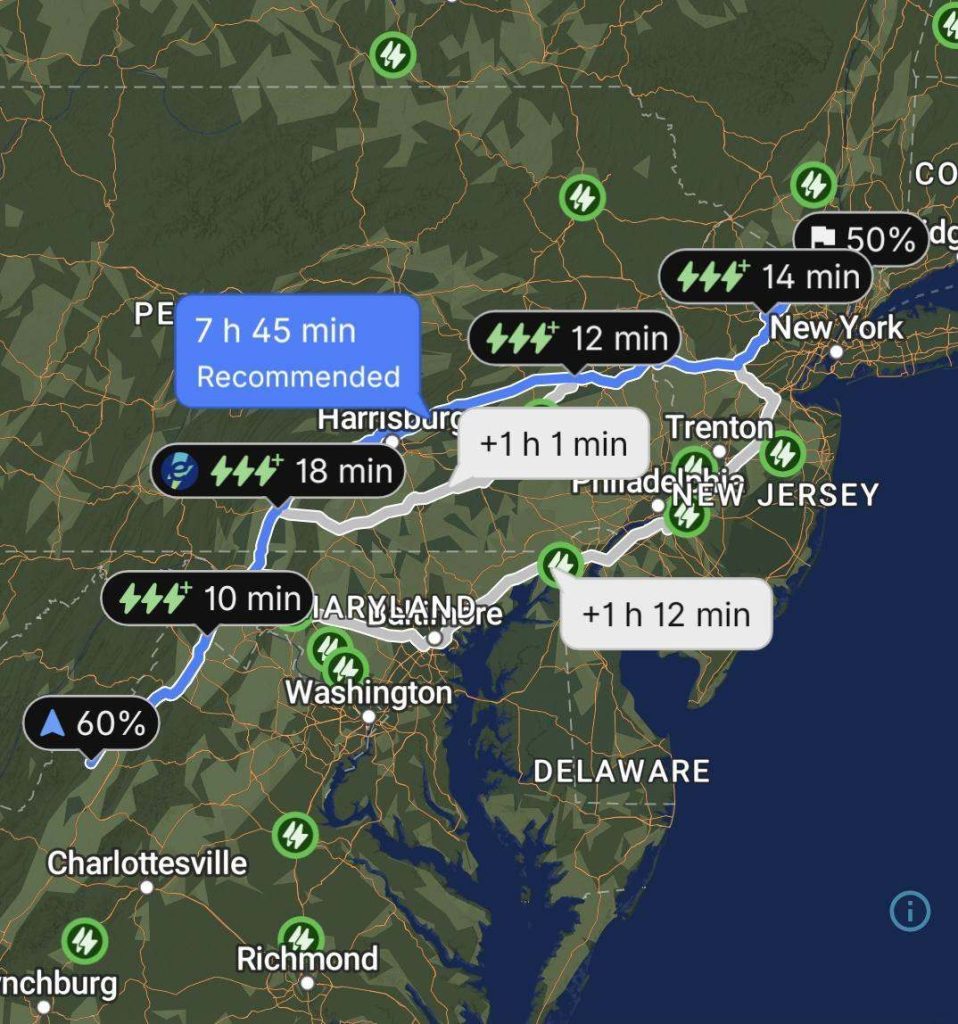 One of the more surprising things I learned was how conservative some route-planning estimates can be.
On our final approach to the destination, we traveled over hilly back roads. The route planner estimated we would use around 30% of the battery on that segment.
Instead, we used closer to 15%.
Throughout the trip, my Ioniq 5 consistently exceeded my expectations for efficiency and range.
(Your mileage may vary)
I also discovered how much confidence comes from familiarity. By the end of the trip, I felt comfortable using a variety of charging networks. Most worked flawlessly. One charging session required a second attempt because my Google Wallet payment didn’t process correctly the first time, but the issue was easily resolved.
Perhaps most importantly, I realized just how many chargers were available that I never even needed to use. We passed numerous charging stations along our route that were never part of our original plan.
The Unexpected Highlight
While visiting family, we took two kids—ages 9 and 13—for a ride in the EV.
They absolutely loved it.
The younger one was fascinated by the digital speedometer because the speed was displayed as a large number rather than a traditional gauge.
They enjoyed changing the interior lighting colors and watching the driver assistance features in action.
At one point, both of them said they wanted an EV when they eventually learned to drive.
The charging station we used happened to be near their school, and they were excited to realize they would be able to see EVs charging when they passed by in the future.
For them, EVs weren’t unusual.
They were just interesting.
And that felt like a glimpse into the future.
From Range Anxiety to Charging Confidence
Before this trip, I was comfortable driving my EV to certain parts of New England.
After this trip, I feel comfortable driving it most anywhere I need to go.
That’s a huge shift.
My range anxiety dropped significantly. My charging confidence increased dramatically. The radius of places I feel comfortable traveling expanded overnight.
Surprisingly, the charging stops themselves became part of the reason the trip felt enjoyable. The breaks were frequent enough to stay refreshed but short enough that they never felt inconvenient. Compared to some of our previous gasoline road trips—where we’d drive until we were hungry, tired, or desperately needed a restroom—the planned stops made the journey feel more relaxed and manageable.
We arrived less tired than expected.
And we never felt rushed.
Will every trip be this easy? Maybe not. Winter driving would require additional planning, battery preconditioning, and different charging expectations. But the biggest lesson remains the same: the hardest part wasn’t charging—it was building confidence.
Perhaps the biggest takeaway from this trip wasn’t about my vehicle at all—it was about the maturity of EV travel. A few years ago, many drivers felt they needed a Tesla to confidently tackle long road trips. Today, there are more vehicles, more charging networks, and more route options available than ever before.
My trip showed that long-distance EV travel is increasingly becoming brand-agnostic. The infrastructure has grown to the point where the focus is less about finding a charger and more about choosing the charger that best fits your needs.
More importantly, I came away with something I didn’t have before: confidence. Confidence in public charging. Confidence in planning. Confidence that my EV can handle trips well beyond my normal driving radius.
If someone tells me they could never go on a road trip in an EV, I’d simply say: don’t let yesterday’s assumptions define today’s experience. A little planning goes a long way, and once you’ve done it once, the world feels a lot closer than you thought.