
Written by Energy New England Staff Member
When I bought my first electric vehicle, I knew that installing a home charger was part of the long-term plan. What I didn’t expect was how quickly I’d need to rethink that plan, or how much I’d learn along the way.
I live in a single-family ranch-style home built in the 1950s. There’s no garage, but I have a driveway alongside the house with space for two to three cars. In November 2025, my gas car reached the point where major repairs no longer made financial sense. I had intended to wait another year or two before switching to an EV, but circumstances pushed the timeline forward. After test-driving a few options, I purchased a used Hyundai Ioniq 5, and suddenly, I was an EV owner figuring things out in real time.
Life Before a Home Charger
Because the purchase happened sooner than expected, I wasn’t fully prepared for home charging. I knew a charger installation was on my home improvement roadmap, but I hadn’t done the planning yet. My car came with a portable Level 1 charger, but I didn’t have an outlet anywhere near the driveway. The available outlets were on the other sides of the house, and using an extension cord felt risky, so I ruled that out.
For about five and a half months, I relied entirely on public charging. That meant building a routine around what was convenient and available.
One of my primary charging locations was my office, where there are Level 2 chargers available at a low cost. I’m in the office about one or two days a week, so when a charger was open, it worked well. The challenge was that there are only three functional chargers and about six EVs and plug-in hybrids that use them. Availability wasn’t guaranteed. Sometimes it meant coordinating schedules or negotiating with colleagues to move vehicles so everyone could get a turn. Since I was newer to EV ownership and many of them had chargers at home, they were often kind enough to defer to me, but I couldn’t rely on that long term.
My other main charging option was a DC fast charger at my local grocery store, about a mile from home. Either my partner or I would take the car to charge while running errands. Under normal conditions, it would fill up in about 20 minutes. In the winter, charging took a bit longer if I couldn’t pre-condition the battery. Fortunately, those chargers weren’t high-traffic, so they were local, affordable, and reliable. The internet connection there is a bit spotty, so if I needed a charge without having groceries to buy, I’d bring a book or my Nintendo Switch and pass the time.
I also took advantage of other opportunities to top off when they fit naturally into my routine. I go to the public library about once a week, and they have Level 2 chargers. And for longer trips, I relied on PlugShare and A Better Route Planner to plan charging stops along the way.
This system worked, but it required planning, flexibility, and mental energy.
The Turning Point
The tipping point came during winter holiday travel. I wasn’t going into the office, so I was relying more heavily on DC fast charging. It was doable, but one moment really stuck with me: pulling up to the fast charger at 12% battery on New Year’s Eve, just so I could feel confident about getting up the next morning in cold weather and going where I needed to go.
I realized then that even slow Level 1 charging at home would have reduced that stress. Having charging available at home would fundamentally change how the EV fit into my life, not just logistically, but emotionally.
Starting the Installation Process
My biggest concern going into the installation process was cost. I was fortunate that my electrical panel is in the basement near the driveway, so the distance to run wiring would be relatively short. The other concern was logistics: the side of my house near the driveway is tight, with an electric meter, chimney, doorway, and garden bed competing for space.
I started by doing online research and talking with colleagues who had already installed chargers. I also reached out to several electricians for estimates, including Qmerit, a local residential electrician, and a family friend who is an electrician.

An Unexpected Electrical Lesson
About two years earlier, I had converted my home from oil to electric heat pumps and upgraded my electrical service from 100 amps to 200 amps. I did that with the expectation that I’d someday install an EV charger and finish my basement.
Last year, I finished the basement and intentionally saved space in the panel for an EV charger breaker. What surprised me in the process was learning that available physical space in the panel didn’t mean available electrical capacity.
During the basement renovation, we added additional heat pumps, new outlets for equipment like lawn equipment battery chargers and a 3D printer, another office space, and supplemental heating in the bathroom to prevent frozen pipes. All of that increased the overall load on the panel.
When I talked with the electrician about installing a 48-amp charger, I learned that by code, we couldn’t add that breaker without exceeding the load thresholds for a 200-amp panel. Even though the charger I initially selected could be set through the app to a lower amperage, that wouldn’t be permitted. To install a 48-amp charger, I would need load management.

Choosing the Right Charger
I narrowed down charger options by looking at utility rebates, reviews, and recommendations, including resources from Tom Moloughney’s videos and website. Since my charger would be installed outdoors, I prioritized models with strong weather ratings and flexible cables in cold temperatures.
I ultimately chose an Emporia charger. Both the standard and Pro versions were eligible for my utility’s off-peak charging program, which offers discounts for overnight charging. When it became clear that load management was required, the electrician and I reviewed several options and settled on the Emporia Pro with integrated load management. It was the most cost-effective option, and the additional equipment fit inside my existing panel once some wiring was rearranged.
 Installation Choices and Tradeoffs
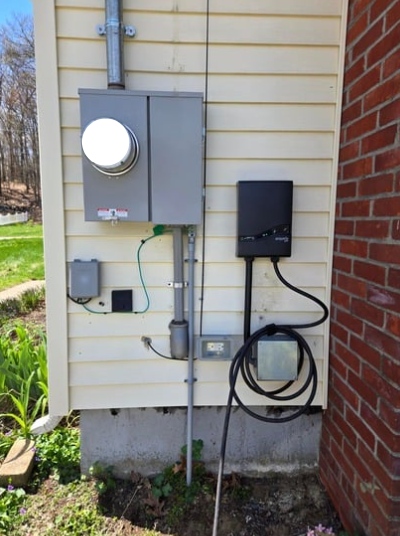
Originally, I imagined installing the charger on a pedestal closer to where the car is parked. In practice, that would have required trenching farther than expected to meet code requirements for access to the meter and shutoff—significantly increasing the cost.
To keep the project affordable, we installed the charger on the wall near the electrical panel. To make daily use easier, I plan to add a post closer to the driveway to hold the charging cable so I don’t have to reach through the garden bed.
While the electrician was already working on the wall penetration, I also had them install a 20-amp outlet near the charger. This gives me the option to use my portable charger if I want to, provides flexibility for a future EV, and is handy for outdoor equipment.
The Role of My Utility
The Energy New England EV Help Desk team played a helpful role throughout the process. The team provided guidance on charger types, available incentives, and reliable resources so I could do my own research and make informed decisions. Following the installation I applied for the level 2 charger installation rebate through my utility to help lower the overall costs.
 Life After Installation
Having a home charger has fundamentally changed my EV experience. I can come home from a long trip without making one last stop. I plug in while I sleep and wake up ready for the next day, or even back-to-back trips, without early morning or late-night charging runs.
I still take advantage of lower-cost charging when I’m at the office, but I no longer depend on it. The biggest benefit for me is mental. I don’t have to plan charging days in advance or worry about whether my partner can take the car for an extra errand. At home, I set the charge level I need and move on.
Financially, my utility’s balanced billing and off-peak charging credits make costs predictable and manageable, often less than what I spent on gas. And there are unexpected lifestyle changes too: I don’t stop at convenience stores for snacks as often. I still swing by gas stations for to fill the tires with air or windshield cleaning, but mostly I enjoy driving past them, knowing I’m reducing my carbon impact.
In our household, my partner’s truck and our propane grill are the last remaining fossil fuel uses. They only fill up the truck once or twice a month. I’m also looking forward to the day when I add solar and can charge directly from the sun.
Advice for Others
If you’re considering installing a home EV charger, my advice is simple: get multiple quotes, be flexible with charger location if costs are a concern, confirm your panel load with an electrician before buying a charger, and take advantage of incentives wherever possible.
For me, the process took longer and involved more decisions than I expected, but the result has been absolutely worth it.
The views expressed are those of the author. Energy New England does not endorse any specific products, brands, or services mentioned in this article.